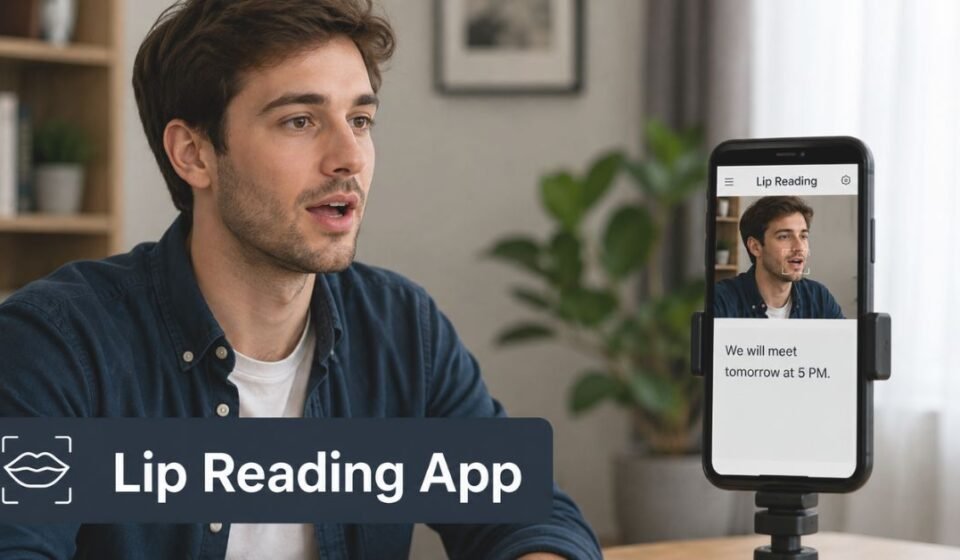

Communication is not always possible through sound alone. Many people rely on visual cues when audio fails or is unavailable. A lip reading app fills this gap by turning lip movements into readable text.
This technology combines artificial intelligence with computer vision to interpret speech without hearing a single word. This article explains everything about lip reading apps clearly and simply.
What is a Lip Reading App?
A lip reading app is a software tool that studies a speaker’s lip movement and converts it into text. It works purely on visual data, not audio.
This process is also called Visual Speech Recognition (VSR). It lets machines “read” speech the way a trained human lip reader would.
How Does a Lip Reading App Work?
The app first takes a video input, either recorded live or uploaded. The speaker’s face and lips must be visible in the frame.
Next, the app breaks the video into individual frames and analyzes each one to track the mouth’s shape and position.
An AI model compares these movements against patterns it has learned. The output appears as a text transcript within seconds.
The Technology Behind Lip Reading
Lip reading apps rely on deep learning models trained on large video datasets. These models connect specific mouth shapes with specific sounds and words.
Neural networks process this visual data layer by layer. Some systems also use models built for sequence data, since lip movement changes over time.
The more diverse the training data, the better the app performs across different faces and angles.
Types of Lip Reading Apps
Not every lip reading app serves the same purpose. Apps in this space fall into two categories.
Transcription Apps
These apps convert lip movement in a video into text using AI. Users upload or record a clip, and the app returns a transcript.
Learning Apps
These apps teach humans to read lips through practice and tutorials. They rely on structured lessons, not automated detection.
Conditions Needed for Best Accuracy
Lip reading apps do not perform equally well in every situation. Certain conditions affect accuracy.
- Good, even lighting on the speaker’s face
- A clear, unobstructed view of the mouth
- A close camera angle while keeping the full face visible
- Only one speaker visible at a time
Following these conditions reduces errors and improves the quality of results.
Real-Life Use Cases of Lip Reading Apps
Lip reading apps serve several practical purposes.
Medical & Healthcare
Patients who cannot speak due to surgery or medical devices can communicate through lip movement alone.
Deaf & Mute Community
These apps offer a way to understand speech or express words without relying on sound.
Emergency & First Responders
Responders can quickly understand patient needs even when verbal communication is not possible.
Noisy Environments
In loud places like construction sites, lip reading apps can decode speech where audio fails.
Content Creation
Creators can generate captions for silent or low-quality audio footage.
Forensic & Investigation
Investigators use this technology to extract speech from silent security footage.
Popular Lip Reading Apps in 2026
Several apps currently operate in this space.
| App Name | Platform | Main Purpose |
| AI Lip Reading – Video Reader | iOS | Converts recorded video into text transcripts |
| Lip Reading AI | Android | Translates short lip movement clips into text |
| Lip Reading Academy | Android | Teaches users how to read lips manually |
| LipRead Pro | Web | Processes uploaded video files for transcription |
This variety shows that the market serves both AI-based tools and skill-based learning tools.
Lip Reading App vs Speech-to-Text App: What’s the Difference?
A lip reading app depends only on visual input, such as lip movement in a video. It does not need any audio.
A speech-to-text app converts spoken audio into written text instead. It fails completely when there is no sound.
These two technologies solve different problems, though people often confuse them.
Limitations and Challenges of Lip Reading Technology
Lip reading technology still faces real obstacles despite rapid progress. Every speaker moves their lips differently, which makes accuracy difficult.
Poor lighting, face masks, or hand movements near the mouth can block the camera’s view. Real-time processing also remains harder than pre-recorded video.
These challenges show the technology is still improving, not fully complete.
Is AI Lip Reading 100% Accurate?
No lip reading app guarantees perfect accuracy in every situation. Results depend heavily on lighting, camera angle, and how clearly the speaker moves their lips.
We tested a few of these apps ourselves, and the results matched most user reviews. Accuracy dropped noticeably outside calm, well-lit conditions.
Treating these apps as a helpful aid, not a flawless solution, sets realistic expectations.
How to Learn Lip Reading Yourself
Learning lip reading manually is possible with consistent practice. It does not require any app to begin.
Start by watching people speak without sound and guessing the words. Practicing common phrases and paying attention to mouth shapes builds this skill gradually over time.
The Future of Lip Reading Apps
Lip reading technology is likely to keep improving as training datasets grow larger. Better models should reduce errors caused by lighting and camera angle.
Wider adoption in healthcare and accessibility tools also appears likely as AI models advance.
Ethical and Privacy Concerns of Using Lip Reading Apps
Lip reading apps can interpret speech from silent footage without consent. Recording someone’s lip movement without permission could expose private conversations.
Users should confirm they have the right to record and process someone’s video before using such tools.
Who Benefits Most from a Lip Reading App?
Certain groups gain more value from this technology than others. People with hearing loss, patients unable to speak, and professionals in loud environments benefit the most.
Casual users exploring the technology out of curiosity should expect limitations, not expert-level accuracy.
FAQs
Can AI really read lips?
Yes, AI can interpret lip movement using trained models, though accuracy varies by conditions.
Is it possible to learn lip reading without an app?
Yes, practicing with silent videos and real conversations helps build this skill manually.
Do these apps work in poor lighting?
No, poor lighting reduces accuracy significantly since the app depends on clear visual input.
Do lip reading apps need an internet connection?
Most apps need internet access since processing usually happens on remote servers.
Can these apps read lips in any language?
Not always, since accuracy depends on whether the app was trained on that specific language.
Is my video data safe when using these apps?
It depends on the app’s privacy policy, so users should check it before uploading personal videos.
Conclusion
A lip reading app turns silent lip movement into readable text using AI and computer vision. It serves real needs in healthcare, accessibility, and noisy environments, though it is not perfectly accurate yet.
Understanding how this technology works, along with its limits and ethical use, helps users apply it responsibly and effectively.
Disclaimer:
This article is for informational purposes only and does not guarantee the accuracy or performance of any lip reading app mentioned. Always verify features, pricing, and privacy policies directly from the app’s official source before use.
Read more topics on :Instamagazine.co.uk